Thunderbolt 5 Hub vs Dock: Which Is Better for Your Mac?

Thunderbolt 5 vs USB4: Which Dock Do You Actually Need?

Sep 3, 2026

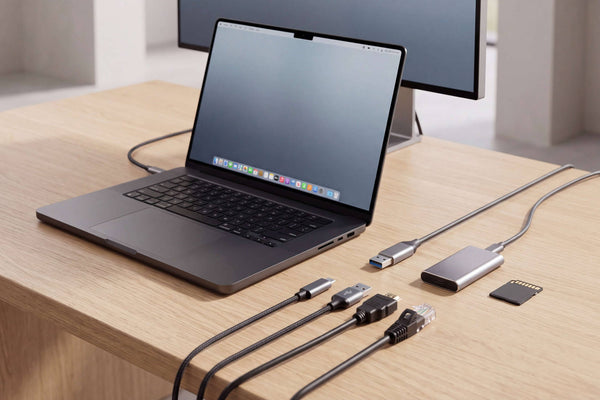
A Thunderbolt 5 hub and a Thunderbolt 5 dock can look similar on a product page, but they are built around different priorities. A hub is mainly for adding more high-speed Thunderbolt connections. A dock is meant to replace more of your desk adapters by integrating things like Ethernet, card readers, audio, USB, and display connectivity into one box.


For most Mac users, the choice is simpler than the names make it sound: buy a hub if most of your gear is already Thunderbolt or USB-C and you mainly need more fast connections; buy a dock if you want one device to run the whole desk.


This guide covers Apple silicon Macs. Windows display behavior can be different.

AT A GLANCE

Thunderbolt 5 Hub vs Dock

The difference is less about which category is more powerful and more aboutwhat kind of connectivity your desk actually needs.

Comparison of Thunderbolt 5 hubs and Thunderbolt 5 docks by use case,connectivity, displays, charging, size, and adapter dependence.
DimensionThunderbolt 5 HubThunderbolt 5 Dock
Best forAdding more high-speed Thunderbolt connectionsBuilding a complete desktop setup
Thunderbolt connectivityUsually the main focusIncluded, but the number of ports varies
Built-in desktop I/OUsually limitedTypically broader
Ethernet / card reader / audioOften absent or requires adaptersCommonly integrated
DisplaysUsually through downstream TB ports or adaptersMay use TB plus HDMI/DisplayPort, depending on the dock
Host chargingCan still be high-powerOften high-power on premium models
Desk sizeUsually smallerUsually larger
Adapter dependenceHigher if you need mixed I/OLower for a full desktop
Choose this if...Most of your peripherals are already TB/USB-CYou want one device to handle most of the desk

The table is more useful than the product label alone. Thunderbolt 5 hubs can be powerful devices: current examples deliver substantial charging power, drive monitors, and connect very fast storage. The difference is less about “basic vs premium” and more about what kind of connectivity the device is designed to concentrate in one place.

What's the difference between a Thunderbolt 5 hub and a dock?

A Thunderbolt 5 hub is built around expanding Thunderbolt connectivity.

Current Thunderbolt 5 hubs commonly prioritize multiple downstream Thunderbolt connections, usually alongside a smaller set of general-purpose USB ports. That layout makes sense when your desk already revolves around Thunderbolt or USB-C devices: fast external SSDs, Thunderbolt storage arrays, USB-C monitors, capture devices, or other high-bandwidth peripherals.

A Thunderbolt 5 dock usually starts from a different question:

That often means Ethernet, a card reader, audio, USB-A, USB-C, charging, storage, and display connections in the same chassis.

The easiest way to remember it is:

A hub gives you more high-speed connections. A dock gives you more of the desk in one box.

QUICK REFERENCE

Native External-Display Support

A quick host-level reference for common Apple silicon MacBook configurations.

Quick reference showing native external-display support for commonApple silicon Mac chip configurations.
Mac chip / common MacBook caseNative external-display support
Base M1 / M21
Base M31 with lid open; up to 2 with lid closed
Base M4 / M5Up to 2
M1–M4 ProUp to 2
M5 ProUp to 3
M1–M5 MaxUp to 4

Important:This is a quick host-level reference, not a promise that every hub or dockcan route every listed display combination. Resolution, refresh rate,macOS version, connection method, and accessory design still matter.

Important: This is a quick host-level reference, not a promise that every hub or dock can route every listed display combination. Resolution, refresh rate, macOS version, connection method, and accessory design still matter.

The line between hub and dock is blurrier than the names suggest

A hub is not automatically the “smaller, weaker” version of a dock.

Thunderbolt 5 itself supports high-bandwidth data, display output, and power delivery over the same connection, so a well-equipped hub can still handle fast storage, compatible displays, and laptop charging. The exact charging power and display support depend on the model. If your display uses Thunderbolt or USB-C, it may connect directly; HDMI or DisplayPort monitors can often be used through a suitable adapter.

So the absence of a dedicated HDMI port does not mean a Thunderbolt hub cannot run a monitor.

What hubs usually do not prioritize is the rest of the desktop: built-in Ethernet, SD/microSD readers, audio, and a wide mix of legacy and modern ports.

That is why shopping by the word “hub” or “dock” alone can be misleading. Look at the actual port mix and the job you need the device to do.

When a Thunderbolt 5 hub is enough

A hub is often the better choice when your setup is already fairly simple and modern.

It makes sense if you:

  • connect several Thunderbolt SSDs, enclosures, or other high-bandwidth peripherals;
  • already use USB-C or Thunderbolt monitors;
  • get Ethernet and USB expansion from your monitor, or do not need wired networking;
  • rarely use SD cards or a 3.5mm audio connection;
  • want a smaller device on the desk;
  • do not want to pay for a long list of ports you are unlikely to use.

For this kind of setup, adding a full dock can actually create more hardware than you need.

Current Thunderbolt 5 hubs in this category focus on turning one host connection into multiple high-speed downstream connections while keeping the device relatively compact.

If that describes your desk, a hub is not a compromise. It may simply be the more efficient choice.

When a Thunderbolt 5 dock makes more sense

A dock becomes more useful when your Mac regularly lives at a desk and needs to connect to several different kinds of equipment.

Typical signs include:

  • you want built-in Ethernet instead of a separate USB adapter;
  • you regularly ingest photos or video from an SD or microSD card;
  • you use speakers, headphones, a microphone, or other audio gear;
  • you still have several USB-A peripherals;
  • you want displays, storage, networking, charging, and peripherals connected through one central device;
  • reducing cable clutter matters more than minimizing the size of the hub or dock itself.

This is also why searches such as “Thunderbolt 5 hub with Ethernet” often lead users toward products sold as docks. The name is not a strict technical boundary, but once you start asking for several categories of built-in desktop I/O, you are effectively shopping in dock territory.

Hub or dock? Three quick examples

Thunderbolt 5 provides 80Gbps of bidirectional link bandwidth. When display traffic needs more room, Bandwidth Boost can reconfigure the link for up to 120Gbps in the transmit direction and 40Gbps in the other direction.

USB4 Version 2.0 can also provide an 80Gbps link and defines an optional asymmetric 120/40Gbps mode.

An 80Gbps label does not mean an SSD will copy files at 80Gbps. Displays, storage, networking and other devices share the link, and each subsystem has its own limits. The controller design, PCIe tunneling, SSD, thermals and host computer all affect actual throughput.

Instead of asking which dock says 80Gbps, ask:

Setup 1: Fast storage + one or two USB-C displays

You have a MacBook Pro, two Thunderbolt SSDs, and USB-C monitors. Your network is Wi-Fi and you almost never use SD cards.

Start with a hub.

The things you care about are already Thunderbolt/USB-C, so a broader dock may not add much value.

Setup 2: Home-office desk

You connect one or two monitors, wired Ethernet, a keyboard, mouse, webcam, speakers, and a couple of USB drives every day.

A dock probably makes more sense.

The benefit is not simply “more ports.” It is removing several separate adapters and leaving one desktop connection point.

Setup 3: Photo or video workstation

You use fast external storage, multiple displays, wired networking, SD cards, audio gear, and several USB peripherals.

You are firmly in dock territory.

At this point, pay particular attention to display compatibility, downstream Thunderbolt ports, card-reader speed, Ethernet speed, and host charging—not just the total number of ports.

If you need a dock, what should you look for?

Once you know you want a dock, check these five things before comparing model names.

1. Display support
Check both your Mac's capability and the exact display configurations the dock supports. “Thunderbolt 5” by itself does not guarantee a particular number of external displays.

2. Downstream Thunderbolt ports
If you use fast SSDs, Thunderbolt monitors, capture hardware, or other high-bandwidth devices, make sure the dock leaves enough high-speed ports free after your displays are connected.

3. Ethernet
2.5GbE is a useful step up for many modern home-office and creator setups. 10GbE makes more sense if your network and NAS workflow can actually use it.

4. Card reader, USB, and audio
Count the ports you use every day, not the biggest number printed on the product page.

5. Host charging
Choose enough power for your MacBook and your workload. High-performance MacBook Pro users should pay more attention to charging capability than Mac mini or Mac Studio users.

Where FusionDock fits

FusionDock sits on the dock side of this decision. It is designed for users who want broader desktop connectivity rather than simply more Thunderbolt ports.

Two current Thunderbolt 5 examples cover two different kinds of Mac desk.

FusionDock Pro 3: a single-cable dual-display desk

FusionDock Pro 3 is the more streamlined option.

It uses a single Thunderbolt 5 upstream connection and is currently specified for up to dual 6K@60Hz on compatible MacBook setups. It also integrates 2.5GbE, an SD 4.0 reader, audio, USB, three downstream Thunderbolt 5 ports, and up to 140W laptop charging.

That makes it a better fit when the goal is:

one MacBook + one cable + a complete two-display desktop.

FusionDock Max 2: a larger Mac workstation

FusionDock Max 2 is designed around a broader workstation setup.

Its dual-cable host architecture gives it a different role from a typical one-cable Thunderbolt hub or dock. It combines Thunderbolt 5 with 23 ports, 140W MacBook charging, card readers, wired networking, audio, USB, and multi-display connectivity.

It makes more sense when the desk itself is the priority: more peripherals, more connectivity, and more demanding multi-display Mac workflows.

If all you really need is three downstream Thunderbolt ports for storage and monitors, though, a dedicated Thunderbolt 5 hub can still be the better purchase.

Thunderbolt 5 hub vs dock: the simple decision

You do not need to choose based on which category sounds more powerful.

Choose based on what is already on your desk:

  • Mostly Thunderbolt / USB-C devices? Start with a hub.
  • Ethernet + cards + audio + mixed USB + displays? Start with a dock.
  • Buying mainly for multiple monitors? Check your exact Mac and the accessory's display support before either one.
  • Not sure? List the cables currently plugged into your Mac. If most of them would still need adapters with a hub, you probably want a dock.

The best Thunderbolt 5 setup is not the one with the longest spec sheet. It is the one that replaces the most friction in your actual workflow.

Next step

Start with the devices already on your desk.

If most of them are Thunderbolt or USB-C and your goal is simply to create more fast connections, look at a Thunderbolt 5 hub.

If your desk needs Ethernet, card readers, audio, mixed USB devices, displays, and charging in one place, look at a Thunderbolt 5 dock.

And if displays are the deciding factor, check the exact Mac and exact hub or dock combination before buying—the Thunderbolt 5 logo alone does not tell you how many screens your setup will support.

Frequently Asked Questions

What's the difference between a Thunderbolt hub and a dock?

A Thunderbolt hub typically focuses on giving you more high-speed Thunderbolt connections. A dock typically integrates a broader mix of desktop I/O, such as Ethernet, card readers, audio, USB, and display connectivity.

The boundary is not absolute, so always check the actual ports rather than relying only on the product name.

Can a Thunderbolt 5 hub run monitors?

Yes. Compatible Thunderbolt or USB-C monitors can connect through downstream Thunderbolt ports, and HDMI or DisplayPort displays can often be used through suitable adapters.

The number, resolution, and refresh rate of displays still depend on the host Mac and the hub's supported configuration.

Does a Thunderbolt 5 hub have Ethernet?

Some products blur the category boundary, but hub-focused Thunderbolt 5 designs often prioritize downstream Thunderbolt and USB connectivity rather than built-in Ethernet. If built-in Ethernet is a requirement—especially alongside card readers, audio, and mixed USB—you will usually find more options in the dock category.

Is a Thunderbolt 5 dock faster than a Thunderbolt 5 hub?

Not simply because it is called a dock.

If both products use Thunderbolt 5, their real performance depends on their internal architecture, host connection, connected devices, bandwidth sharing, and supported data paths. A dock mainly gives you a broader mix of integrated I/O; that does not automatically make every connection faster than a hub.

Will a hub or dock give me more displays than my Mac supports?

A native Thunderbolt hub or dock cannot bypass your Mac's native external-display capability.

Actual support also depends on connection method and the accessory's display-routing design. Software-assisted graphics products such as DisplayLink are a separate category.

If multi-display support is your main concern, see our guide to Mac external-display limits and Thunderbolt display routing.