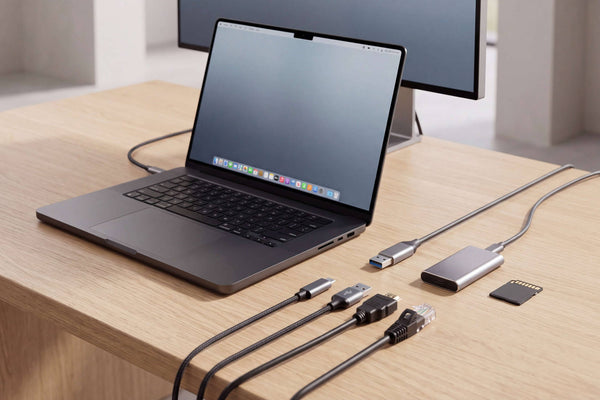
A Thunderbolt 5 cable carries 80Gbps of bidirectional data over a USB-C connector — and, when a high-bandwidth display needs it, up to 120Gbps toward that display — plus up to 240W of power. You need one when a link in your setup runs Thunderbolt 5 and you want that link to run at TB5-class speed: between a TB5 laptop and a TB5 dock, or between a TB5-class dock port and a TB5 SSD, display, or capture device. It also works backward with Thunderbolt 4/3 and USB4 at their host speeds. One thing it can't do: no cable makes a Mac drive more displays than its chip supports.
Most people searching "thunderbolt 5 cable" aren't cable engineers. They've just bought a dock or a fast SSD and want to know which cord goes where — and whether the one in the box is enough. That's what this guide settles.
What a Thunderbolt 5 Cable Actually Is
A Thunderbolt 5 cable looks like any USB-C cable. It isn't. Inside, it's built to move 80Gbps in both directions at once, with a display-boost mode that can shift up to 120Gbps toward a monitor when that monitor needs the bandwidth. It also carries up to 240W of power delivery, so one cord can charge a 16-inch MacBook Pro while running displays and a pile of peripherals.
The practical difference shows up in real work: an 80Gbps class cable can stream 8K video, run a multi-display desk, and saturate a fast external SSD. A plain USB-C cable tops out far below that.
Thunderbolt 5 vs. USB-C: Same Connector, Different Capability
Yes, the plug is identical — Thunderbolt 5 uses the USB-C connector. That's why the two get confused.
The difference is in what the cable and the ports on each end negotiate. USB-C is the connector shape; the technology inside that connector can be anything from USB 2.0, to USB 5/10/20Gbps, to USB4 40/80Gbps, to Thunderbolt 3/4/5, to DisplayPort Alt Mode, to USB Power Delivery. A Thunderbolt 5 cable is built for the full 80/120Gbps path and the 240W power envelope. Plug a cheap USB-C cable into a Thunderbolt 5 port and the whole chain drops to that cable's speed.
Check the specs and the product description, not the connector shape.
80Gbps vs. 120Gbps: What Bandwidth Boost Means
Thunderbolt 5's headline number is 80Gbps — that's the bidirectional baseline, and it applies to everything: file transfers, networking, and video alike. The 120Gbps figure is Bandwidth Boost, a separate, asymmetric mode that reallocates lanes so more bandwidth flows one way, toward a display.
Two things matter here, and both are easy to miss:
Boost is display-only. It activates only when a monitor (or capture device) needs the extra bandwidth — say, a high-refresh 4K/8K panel. File transfers and storage traffic do not use Boost; they run at the 80Gbps bidirectional rate.
Boost doesn't make files move faster. If you copy a large project over a "120Gbps" cable, the transfer runs at whatever the chain delivers — typically far below even 80Gbps once the SSD and protocol overhead are counted.
So when you shop: a cable advertised with "120Gbps Boost" is built for the display-boost path and is fully capable at the 80Gbps baseline. A cable rated only at 80Gbps may not support the boost path at all. If you drive high-refresh 4K/8K displays, the boost-capable cable is the safer pick; if your work is mostly storage and networking, an 80Gbps-class cable is enough — the boost simply never comes into play.
Active vs. Passive Cables: Length and Bandwidth Tradeoffs
A Thunderbolt 5 cable under about 1 m is usually passive — no signal-conditioning electronics, cheaper, and fully reliable at full speed.
Past roughly 1–2 m, passive cables start losing signal integrity. That's where active cables come in: they embed a chip that re-drives the signal, letting a 2 m cable hold full Thunderbolt 5 performance. You'll see vendors advertise "full-speed 2 m" cables for exactly this reason.
Practical rule: for a desk, a 1 m cable is often all you need — it's cheaper and there's less cable to manage. For a wall-mounted display, a standing desk, or a setup where the Mac sits across the room, budget for an active cable at 2 m or longer.
Compatibility: Backward and Forward
Thunderbolt 5 cables are built to work backward with what you already own:
Thunderbolt 5 host → full 80/120Gbps
Thunderbolt 4 / USB4 host → runs at 40Gbps (the host's ceiling), still carries video and up to 240W-class power
Thunderbolt 3 host → 40Gbps-class, works
USB-C / USB 3.x host → runs at that port's USB speed; video only if the port supports Alt Mode
The rule of thumb: a Thunderbolt 5 cable never makes anything slower than its port allows, and it's ready for your next laptop. Apple's own Thunderbolt 5 Pro Cable, for example, is rated 120Gbps with fallback to 80Gbps for TB4/3 and USB4 — the same backward-compatible design you should expect from a TB5 cable built to spec.
When Do You Actually Need a Thunderbolt 5 Cable?
A Thunderbolt 5 cable earns its keep on three kinds of links — the ones where both ends are TB5-class and you actually want that speed. Everywhere else, a cheaper cable does the same job. Here are the real scenarios, in the order they usually come up.
1. Mac → Thunderbolt 5 dock (the host cable)
This is the one most people need. When your Mac and your dock both support Thunderbolt 5, a Thunderbolt 5 cable — or a matching USB4 80Gbps-class cable — is what lets the link run at its full 80/120Gbps. The negotiated speed ends up at the common capability of three things: the Mac's port, the dock's upstream port, and the cable itself. That means a TB5 cable can't make a Thunderbolt 4 Mac faster, and a cheap cable can pull a TB5 link down to USB speeds.
Two things to check beyond the connector:
"USB4" isn't one speed. USB4 comes in different performance tiers (40Gbps-class and 80Gbps-class, among others). A cable that just says "USB4" doesn't guarantee an 80Gbps link.
Power matters too. The host cable also carries your laptop's charging, so make sure its power-delivery rating matches what your Mac needs — not just the data speed.
2. Dock → Thunderbolt 5 SSD or storage
Plugging a Thunderbolt 5 SSD or enclosure into a downstream port? A Thunderbolt 5 cable is the right call so that storage link can run at its full rate. On the FusionDock Ultra, Max 2, and Pro 3, the downstream Thunderbolt ports are 80/120Gbps-class, so a TB5 cable lets a TB5 drive hit full speed there. On the FusionDock Max 1, the downstream Thunderbolt is 40Gbps-class, where a 40Gbps cable already matches it.
The caveat: a TB5 cable never makes a slower drive faster. A 10Gbps or 20Gbps USB SSD stays at its own speed no matter what cable you use, and a 40Gbps Thunderbolt 4 drive is fully served by a 40Gbps cable. And interface bandwidth isn't the same as file-transfer speed — the host, dock, enclosure controller, drive, and whatever else is sharing the link all set the real ceiling.
3. Dock → Thunderbolt 5 display
A Thunderbolt 5 display benefits from a TB5 cable. But don't reach for one automatically: many USB-C monitors don't use Thunderbolt at all — they run DisplayPort Alt Mode over USB-C, and a full-featured USB-C cable that supports your target resolution and refresh rate is enough. Only a display that actually talks Thunderbolt 5 needs the TB5 cable. (This is also the one place Bandwidth Boost comes into play — it's a display-only mode, as covered above.)
What doesn't need one
Keyboards, mice, audio interfaces, printers, and ordinary USB accessories run on a few Gbps at most — an ordinary USB cable is all they need. A Thunderbolt 5 cable on these links buys you nothing.
At a glance
At a glance
Do you actually need a Thunderbolt 5 cable?
Match the cable to the link. Thunderbolt 5 matters when both ends are TB5-class and you want TB5-class bandwidth; slower devices do not become faster just because the cable supports more.
Thunderbolt 5 cable requirements by connection type
Connection
Do you need a Thunderbolt 5 cable?
Mac (TB5) → TB5 dock
Yesor a matching USB4 80Gbps cable (Max 2 / Ultra use a dual-cable connection)
Dock downstream → TB5 SSD / storage
Yes
Dock downstream → TB5 display
Yes
Dock downstream → USB-C display (DP Alt Mode)
Noa full-featured USB-C cable
Dock downstream → TB4 / USB4 40G device
Noa 40Gbps cable matches it
Dock → USB 10/20G drive
Noa cable rated for its USB speed
Dock → keyboard / mouse / audio
Noan ordinary USB cable
The rule in one line: buy a Thunderbolt 5 cable only for links where both ends are TB5-class and you actually want that speed. For everything else, match the cable to the device you're plugging in.
Why Your Transfer Speed Isn't 120Gbps
Short answer: it isn't supposed to be. File transfers never use Bandwidth Boost, so a healthy TB5 storage run lands at the 80Gbps class — and usually well below that in practice. If a transfer feels slow, work down the chain:
Host port — does the laptop have Thunderbolt 5? A TB4/USB4 port caps the upstream link at 40Gbps regardless of cable.
Dock port — is the peripheral in a downstream Thunderbolt/USB4 port or a slower USB port, and what tier does that port negotiate (40G vs 80G)?
Cable — is it rated for Thunderbolt 5 speeds, and is the connector fully seated? A cable not built for TB5 bandwidth can silently drop to USB speeds.
Drive + enclosure — an SSD's real speed is set by its controller and the enclosure's chipset. Many "10Gbps" enclosures peak around 8–9Gbps.
Protocol overhead — real-world file throughput is always below the spec number.
Concurrent displays — video traffic shares the link; a triple 6K desk leaves less headroom for storage.
Fix the weakest link first — usually it's not the cable.
The Short Version
Buy a Thunderbolt 5 cable for the links that can actually use it: a TB5 Mac to a TB5 dock, a dock's TB5-class downstream port to a TB5 SSD, or to a TB5 display. Everywhere else — USB-C monitors, 40Gbps drives, ordinary peripherals — a cheaper cable does the same job. A 1 m cable covers most desks; go active at 2 m+ for long runs. And remember: the cable can't raise your Mac's display limit, and the host-to-dock link is just one of the limits on real-world speed.
If you're building a Thunderbolt 5 desk, iVANKY's Thunderbolt 5 cable (120Gbps-capable, up to 240W) is available separately, and the FusionDock Max 2 and Ultra ship with the dual Thunderbolt 5 cable their dual-chip design needs.
Frequently Asked Questions
Is Thunderbolt 5 the same as USB-C?
No. USB-C is the connector shape; Thunderbolt 5 is one of several technologies that can run over it. A Thunderbolt 5 cable uses the USB-C plug but is built for the full 80/120Gbps path and 240W power — a plain USB-C cable is not.
What is a Thunderbolt 5 cable for?
It carries 80Gbps of bidirectional data (up to 120Gbps in display-only Bandwidth Boost mode) plus up to 240W of power, for Thunderbolt 5 laptops, docks, SSDs, and displays.
Can I use a USB-C cable in a Thunderbolt 5 port?
Yes, physically — but the link drops to the USB-C cable's speed. To run at TB5-class speed, use a Thunderbolt 5 or matching USB4 80Gbps-class cable.
Is Thunderbolt 5 the fastest cable?
Among current consumer cables, Thunderbolt 5 (alongside USB4 80Gbps) offers the highest bandwidth. But "fastest" depends on your devices — a TB5 cable won't make a 10Gbps or 40Gbps device faster.
Why is my transfer speed not 120Gbps?
Because 120Gbps is a display-only mode. File transfers always run at the 80Gbps class, and real-world speed is further limited by your SSD, enclosure, and host.