
Thunderbolt 5 Dock Ports Explained: What Matters for Mac

A Thunderbolt 5 dock with 23 advertised ports isn't automatically more capable than one with 11. The numbers don't tell you how many high-speed devices you can connect, which USB-C ports can drive a monitor, or whether the dock will work with your Mac's display setup.
The better way to compare docks is to read the port map in this order: identify the connection to your Mac, count the downstream Thunderbolt ports, check the speed and power of ordinary USB ports, confirm the display connections, and then match the remaining ports to your daily devices.
We'll walk through that process with a Port Value Map and two practical Mac desk examples. By the end, you should be able to look at almost any Thunderbolt 5 dock's specifications and tell whether its particular mix of ports fits your setup.
If you're still deciding whether you need a hub or a full docking station, start with our [Thunderbolt 5 hub vs. dock guide]. This article assumes you're already comparing docks.
Why Total Port Count Doesn't Tell the Whole Story
1. Find the Host Connection Before Counting Anything Else

2. Do You Need Two or Three Downstream Thunderbolt 5 Ports?
| Devices you use at the same time | Two downstream TB5 ports | Three downstream TB5 ports |
|---|---|---|
| One Thunderbolt SSD | Usually sufficient | Another direct TB connection remains available |
| Thunderbolt SSD + Thunderbolt display | Often sufficient, subject to display compatibility | One direct TB connection remains available |
| Thunderbolt SSD + Thunderbolt display + Thunderbolt RAID or capture device | May require a compatible daisy chain, a different connection, or a different dock | Three devices can have direct physical TB connections, subject to system limits |
| Keyboard, mouse, webcam, and standard USB SSD | The extra TB port may bring little benefit | The extra TB port may still go unused |
A Thunderbolt daisy chain can help when you run out of direct connections, but both the intermediate device and the connection chain must support it. A monitor with a single USB-C input, for example, doesn't automatically offer a downstream Thunderbolt port for another device.
More connections also don't guarantee faster simultaneous SSD transfers. Real throughput depends on the Mac, dock architecture, connected devices, PCIe capability, and whatever else is using the same path.
Does “120Gbps Thunderbolt 5” Mean 120Gbps SSD Transfers?
No. Thunderbolt 5 normally offers up to 80Gbps in each direction. Its Bandwidth Boost feature can shift the link allocation to up to 120Gbps in one direction and 40Gbps in the other when high display-bandwidth demand calls for it. That is not a promise of 120Gbps file-transfer performance, nor is it a separate 120Gbps data pipe for every downstream port.
Intel explains the mechanism in its [official Thunderbolt 5 introduction]. For a fuller generational comparison, read our [Thunderbolt 5 vs. Thunderbolt 4 guide].
3. Decode USB-C, USB-A, and Charging Labels
- Data rate (Gbps or Mbps): the interface's advertised signaling rate; not a guarantee of real-world file-transfer speed.
- Device power output (W): how much power a particular downstream port can supply to connected accessories, potentially shared across ports.
- Host charging (W): how much power the dock can deliver to the Mac over a supported upstream connection; this is separate from downstream power.
4. The Port Value Map: Compare Capabilities, Not Just Connectors
| Port category | What to verify on the spec sheet | Video output? | Charging or power consideration | Most useful for |
|---|---|---|---|---|
| Upstream / host TB or USB-C | Number of connections to the Mac; supported host standards and Mac models | Carries supported display traffic between Mac and dock | Check host charging wattage; not a spare accessory port | Connecting the dock to the Mac |
| Downstream Thunderbolt 5 | Number of ports; Thunderbolt version; supported devices and display routes | Commonly yes, subject to Mac and dock capabilities | Check power output per port | Thunderbolt SSDs, compatible monitors, RAIDs, capture gear |
| USB-C 10Gbps data | 10Gbps data rating; any explicit video/Alt Mode support | Only if specified; do not assume | Check output wattage and any shared power budget | USB SSDs, USB capture devices, fast USB peripherals |
| USB-A 10Gbps | 10Gbps data rating | No native monitor output | Accessory power varies | Fast USB-A storage and adapters |
| USB-A 5Gbps | 5Gbps data rating | No native monitor output | Accessory power varies | General USB accessories, external HDDs, webcams |
| USB-A 480Mbps | USB 2.0 / 480Mbps data rating | No native monitor output | Often lower-powered; check the device's requirements | Keyboards, mice, receivers, small dongles |
| HDMI / DisplayPort | Version, resolution, refresh rate, simultaneous-use limits | Yes, for a compatible display | Not a general-purpose charging port | Monitors with matching video inputs |
| SD / microSD | UHS-I vs. UHS-II and supported formats | Nein | Not a host-charging connection | Photo and video ingest |
| Ethernet | 1GbE, 2.5GbE, 10GbE, or other rated speed | Nein | Nicht zutreffend | Wired LAN, NAS, reliable networking |
| Audio / optical audio | Headphone, mic, line-level, combo-jack, or optical function | Nein | Not a general charging port | Speakers, headsets, audio workflows |
| Charging-focused USB-C | Whether it also carries data; charging wattage and sharing | Only if specified | Look for the rated output and shared-power limits | Phones, tablets, and rechargeable accessories |

5. Example: Match a Thunderbolt 5 Dock to a Real Mac Desk
Setup A: A Creator's Everyday Mac Workstation
| Connected device | What it needs from the dock |
|---|---|
| One Thunderbolt external SSD | One compatible downstream Thunderbolt connection |
| One 4K monitor with an HDMI input | One compatible HDMI output, or a display-capable TB/USB-C output and suitable HDMI adapter/cable |
| One 10Gbps USB-C SSD | One 10Gbps USB data connection |
| A UHS-II SD card used for photo/video ingest | One UHS-II card reader to take advantage of the faster card standard |
| A keyboard and wireless mouse receiver | Suitable ordinary USB connections; high-speed ports usually unnecessary |
| A 2.5GbE network connection | One 2.5GbE Ethernet port and a compatible network path |
Setup B: A More Thunderbolt-Heavy Production Desk
6. What Dedicated HDMI, SD, Ethernet, and Audio Ports Change
7. One Upstream Cable or Two? Check Your Mac First
8. How to Compare Any Two Dock Spec Sheets
Häufig gestellte Fragen
Ist Thunderbolt 5 dasselbe wie USB-C?
Do I need three downstream Thunderbolt 5 ports?
Does a 120Gbps Thunderbolt 5 label mean an SSD transfers at 120Gbps?
Can I connect a monitor to any USB-C port on a dock?
Will a Thunderbolt 5 dock work with a Thunderbolt 4 Mac?
Weiterlesen
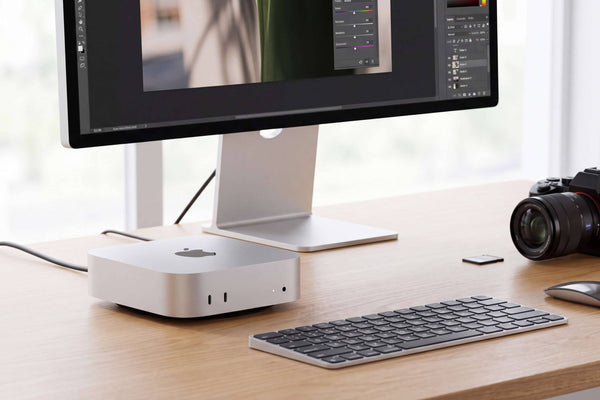
Mac mini Docking Station: USB-C vs Thunderbolt Guide
Choosing a Mac mini docking station? Learn when no dock, a USB-C dock, or Thunderbolt makes sense for displays, SSDs,...
Artikel lesen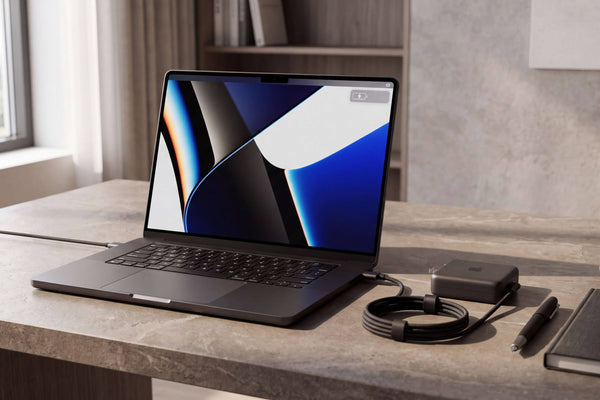
96W vs 140W Dock Charging for 16-inch MacBook Pro
Why 140W USB-C fast charging works on newer 16-inch MacBook Pros but not 2021/early-2023 models, plus our 96W vs 140W...
Artikel lesen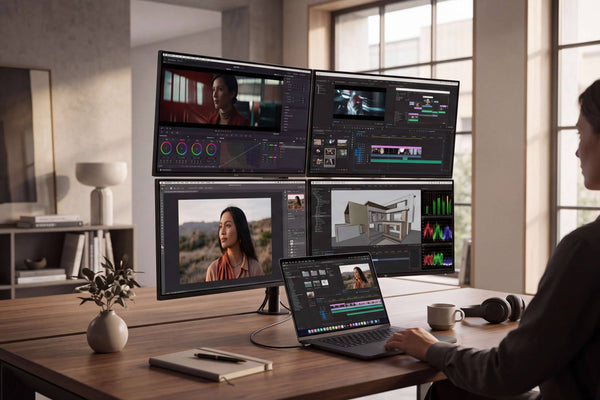
M5 Pro & M5 Max: 3–4 Displays From One Thunderbolt Port
M5 Pro supports 3 external displays and M5 Max 4 from one Thunderbolt port. Learn what changed, why TB5 alone...
Artikel lesen